



Parents hear a lot about the International Baccalaureate (IB), but it is not always obvious how the IB Diploma Programme, the wider IB curriculum and university entry all fit together. In this guide, we explain clearly what the IB is, how the Diploma Programme works for students aged 16–19, how subjects and assessment are organised, and why universities worldwide value it so highly – from the perspective of a parent who needs structure, data and no surprises.
Table of contents
What is the IB (International Baccalaureate)?
The IB (International Baccalaureate) is a globally recognised educational foundation that offers four programmes from primary school to pre‑university level. Its best-known qualification for 16–19 year olds is the IB Diploma Programme (DP), a rigorous two‑year programme that prepares students for entry to universities around the world.
Unlike national systems that focus narrowly on content, the IB is designed to develop knowledge, skills and attitudes: critical thinking, research, communication and international mindedness. At the heart of IB programmes sits the IB learner profile, a set of attributes (thinkers, inquirers, open‑minded, principled, caring, etc.) that frame what kind of person the curriculum aims to develop.
For parents, the key idea is simple: the IB is not just “another curriculum”. It is a coherent educational philosophy backed by a clear structure, standardised assessment and strong university recognition.
How the IB Diploma Programme works (ages 16 – 19)
The IB Diploma Programme is aimed at students aged 16 – 19 and usually takes place in the last two years of secondary school (Year 12 – 13 in the British system, 1º – 2º de Bachillerato in Spain).
At a high level, every full IB Diploma student:
- Studies six subjects over two years
- Takes three (or sometimes four) subjects at Higher Level (HL)
- Takes the remaining subjects at Standard Level (SL)
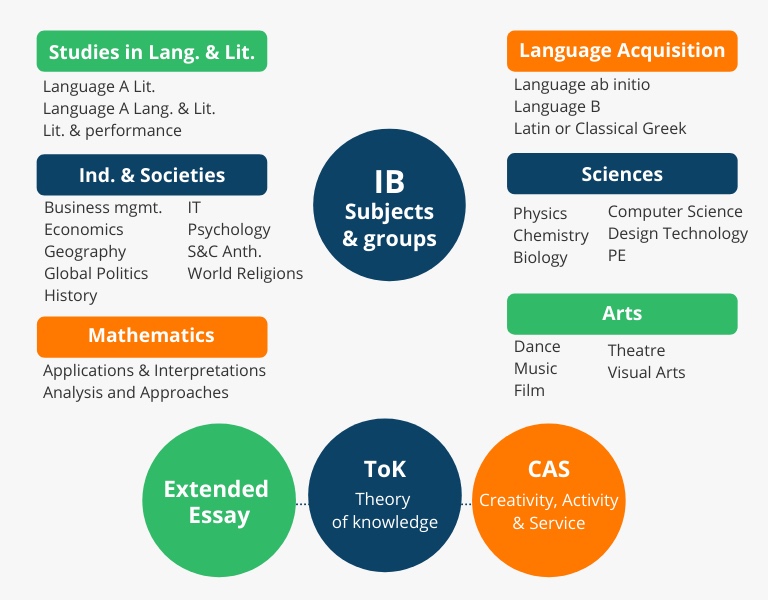
- Completes the IB core:
- Extended Essay (EE)
- Theory of Knowledge (ToK)
- Creativity, Activity, Service (CAS)
The six subjects come from six subject groups:
- Studies in language and literature (usually the student’s strongest language)
- Language acquisition (a second language)
- Individuals and societies (History, Economics, Geography, etc.)
- Sciences (Biology, Chemistry, Physics, Environmental Systems, etc.)
- Mathematics
- The arts (Visual Arts, Music, Theatre) or a second subject from another group
This structure means the IB curriculum is both broad (all major disciplines) and deep (3 – 4 subjects at Higher Level).
For a parent like you: organised, results‑oriented and keen to avoid last‑minute surprises, the DP is attractive because the framework is clear, standardised and predictable across IB schools worldwide.
IB subjects: Higher Level vs Standard Level
One of the first decisions in the IB Diploma is the mix of Higher Level (HL) and Standard Level (SL) subjects.
What is Higher Level (HL)?
- HL subjects go deeper into content and skills
- They typically involve about 240 teaching hours, compared to 150 at SL
- Universities often look carefully at which subjects are taken at HL, especially for competitive courses (e.g. Maths HL and Physics HL for Engineering)
HL is where students show academic depth. For example, a student aiming for Economics or Business at a top university might take:
- Mathematics: Analysis and Approaches HL
- Economics HL
- A strong first language HL
What is Standard Level (SL)?
- SL subjects cover the same broad syllabus but with less depth and fewer topics
- They involve around 150 teaching hours
- They are still demanding and fully examined, but the expectations are slightly lighter
Universities recognise both HL and SL in the final points total, but specific courses may require certain HL subjects (e.g. HL Biology for Medicine in some countries).
How many HL and SL subjects?
A full diploma route usually means:
- 3 subjects at HL
- 3 subjects at SL
Some highly motivated students take 4 HL and 2 SL, but this is demanding and should only be done with a clear strategy and strong academic base.
Parent tip: When choosing subjects, think in three layers:
- What your child enjoys and is good at,
- University entrance requirements,
- Workload balance across HL and SL.
A good IB Academy in Madrid or elsewhere will help you model different pathways and anticipate their impact on predicted grades and university options.
The IB core: Extended Essay, Theory of Knowledge and CAS
The DP core is what makes the IB curriculum distinctive. All full Diploma students must complete:
Extended Essay (EE)
- A 4,000-word independent research project
- On a topic chosen by the student, within an IB subject
- Supervised by a teacher but driven by the student’s initiative
The Extended Essay develops:
- Academic research skills (using sources, referencing, academic honesty)
- Time management over many months
- The kind of writing expected at university
For a parent who values evidence of effort, the EE is useful: you can see very concretely how your child progresses from initial research question to final paper.
Theory of Knowledge (ToK)
ToK is a course about how we know what we know. Students analyse:
- Different ways of knowing (reason, emotion, language, perception…)
- How knowledge works in different disciplines (science vs history, for example)
- Real‑life situations where knowledge claims conflict
Assessment includes:
- A 1,600‑word essay on a prescribed title
- A TOK exhibition based on real‑world objects or situations
ToK cultivates critical thinking, argumentation and reflection, skills highly valued by universities and employers.
Creativity, Activity, Service (CAS)
CAS ensures students do not live only in the world of exams:
- Creativity: arts, music, theatre, projects
- Activity: sport, physical challenges
- Service: volunteering, community initiatives
CAS is not graded with points, but completion is compulsory for the Diploma. Students keep a CAS portfolio and reflect on what they have learned.
For families, CAS is often where you see your child grow as a person, not only as a student: leadership, empathy, initiative and responsibility.
What kind of student does the IB develop? Skills and learner profile
At the heart of the International Baccalaureate is the IB learner profile, a set of ten attributes that all programmes aim to develop: inquirers, knowledgeable thinkers, communicators, principled, open‑minded, caring, risk‑takers, balanced and reflective.
Core skills the IB develops
Across subjects and the core, IB students build:
- Critical thinking: questioning assumptions, evaluating evidence, making reasoned decisions
- Research skills: planning investigations, using academic sources, referencing properly
- Communication: formal essays, oral presentations, group discussions
- Time management: juggling internal assessments, CAS, EE, regular homework and exams
- International mindedness: understanding global issues and different cultural perspectives
These are exactly the skills selective universities, and later employers, look for when they read an IB student’s profile.
How can you see these skills in practice?
As a person who values data, structure and visibility, you will typically see evidence of IB skills in:
- Internal assessments (IAs): research projects in most subjects
- EE drafts and supervisor reports
- ToK presentations and essays
- CAS reflections and logs
A structured IB academy will often share progress reports that break down these elements, so you can see not only grades, but also the underlying skills your child is developing.

We’ll call you!
Please fill in the form and we will contact you as soon as possible.
How is the IB Diploma graded and what is a “good” score?
One of the advantages of the IB Diploma Programme is its transparent scoring system.
The 45‑point system
- Each of the six subjects is graded from 1 (lowest) to 7 (highest)
- This makes a maximum of 42 points from subjects
- TOK and EE together can add up to 3 extra points
- Total maximum score: 45 points
To be awarded the Diploma, students must:
- Achieve at least 24 points in total
- Meet minimum requirements in HL and SL subjects
- Complete all three core components (EE, ToK, CAS) satisfactorily
What is a “strong” IB score?
There is no universal rule, but as a rough guide:
- 24–28 points: sufficient for a pass and entry to many universities
- 30+ points: around or above global average; solid base for a wide range of degrees
- 34–38 points: competitive for many selective universities in Europe and beyond
- 40+ points: outstanding result; opens doors to top global universities, especially if HL choices match course requirements
Universities also look at specific subject grades, especially at HL, not just the total.
How do IB grades compare to other systems?
In the UK, IB scores map to UCAS Tariff points; for example, an HL grade 7 is worth 56 UCAS points, similar to an A* at A‑level.
For Spanish universities and many European systems, official conversion tables translate IB scores into national grades. International schools in Spain are very familiar with these equivalences and use them when advising on university options.
For a parent like you, the key point is that IB grades are standardised and widely understood, making it easier to compare your child’s profile internationally.
Global recognition of the IB by universities
The International Baccalaureate (IB) is one of the most widely recognised pre‑university qualifications in the world.
- As of 2024, more than 5,900 schools in over 140 countries offer IB programmes.
- Each year, over 4,500 universities in more than 110 countries/territories receive IB applications and transcripts.
- The IB itself highlights that recognition by universities is central to its growth and development.
In practical terms, this means:
- UK: Russell Group and other universities routinely make offers based on IB scores (e.g. “38 points with 6,6,6 in HL subjects”).
- USA: IB is considered a strong “college‑preparatory” curriculum; many universities grant advanced standing or credit for high HL grades.
- Europe (including Spain): The IB Diploma is recognised as a university entrance qualification, often with specific score requirements for competitive courses.
For families considering universities in different countries, the IB provides a single, portable academic currency.
The IB continuum: PYP, MYP and Diploma in context
Although this article focuses on the IB Diploma Programme, it is useful to understand the broader IB continuum:
- PYP (Primary Years Programme): ages 3 – 12
- MYP (Middle Years Programme): ages 11 – 16
- DP (Diploma Programme): ages 16 – 19
- CP (Career‑related Programme): ages 16 – 19, more vocational in focus
Students do not have to complete PYP or MYP to join the DP. Many students enter the IB at 16 after another curriculum (British GCSEs/IGCSE, Spanish ESO, etc.).
The value of the continuum is that it offers:
- Consistency in philosophy (learner profile, international mindedness)
- Progression in skills (from basic inquiry in PYP to advanced research in DP)
- A clear educational “story” if your child has been in IB schools from a young age
But even if your child only does the IB Diploma, universities still regard that qualification on its own as a robust preparation for higher education.
Is the IB right for my child? Key questions for parents
Every curriculum has its strengths. The IB suits many students extremely well, but it is not a “one‑size‑fits‑all” solution. Here are practical questions you can ask, especially if you are a parent like Ignacio, who wants to make a well‑informed, data‑driven decision.
How does my child handle breadth and workload?
Because of its six‑subject structure, the IB is ideal for students who:
- Are reasonably strong in several areas (not only in one)
- Can cope with simultaneous demands in languages, maths, sciences and humanities
- Are prepared to maintain consistent effort over two full years
If your child struggles to keep multiple plates spinning, good support and clear planning from Year 1 of the Diploma become even more important.
Is my child ready for independent work?
The IB demands a lot of self‑management, especially with:
- EE planning over many months
- Internal assessments in multiple subjects
- CAS projects alongside regular homework
Students who are organised and proactive tend to thrive. Those who are bright but disorganised can still succeed, but they usually need structured guidance to avoid last‑minute pressure.
Do their university plans fit well with the IB?
For some degrees, the IB is a particularly strong fit:
- Medicine, engineering, sciences: IB’s HL sciences and maths are highly respected
- Economics, business, law: the combination of HL subjects plus TOK and EE is often seen as excellent preparation for analytical degrees
- International relations, politics, humanities: IB’s global perspective and emphasis on critical thinking match these fields well
Checking university entry requirements in the UK, USA, Netherlands, Spain or elsewhere is a useful exercise at the start of the Diploma.
Does our family value what the IB values?
The IB is not only about grades. It emphasises:
- Community engagement (CAS)
- Ethical thinking (ToK)
- Intellectual curiosity (learner profile)
If your family shares these values, or would like to encourage them, the IB will feel coherent with what you want for your child.
How Think Ahead Academy supports IB Diploma students
At Think Ahead Academy, we work with many IB Diploma students (and their parents) every year, including families who want zero improvisation and clear visibility over what is happening.
Academic reinforcement in specific IB subjects
Students often come to us for:
- IB Mathematics (both AA and AI, HL and SL)
- IB Sciences (Biology, Chemistry, Physics)
- IB Economics and Business Management
- IB English / Spanish A or B
Our IB tutors work with the official subject guides and markschemes and focus on:
- Clarifying concepts and exam techniques
- Planning internal assessments in line with IB criteria
- Building confidence before mocks and final exams
Structured support for EE, ToK and CAS
Because the core is so important, we also help students to:
- Refine EE research questions, structure their argument and manage deadlines
- Understand ToK essay titles and develop clear, well‑reasoned arguments
- Organise CAS in a realistic, coherent way, avoiding last‑minute panic
For parents, this means you can see a clear plan for each of these components, instead of relying on last‑minute effort.
Follow‑up and communication with families
Families often tell us they want:
- Regular updates on progress in each IB subject
- Honest conversations about predicted grades and realistic targets
- Clear explanations of how current performance translates into projected IB points
Our approach is to provide structured, predictable communication, so you always know:
- Where your child stands now
- What the next milestones are
- What actions are being taken to improve outcomes
This complements what the school offers and gives you an additional layer of academic monitoring.
FAQs about the International Baccalaureate (IB)
What age is the IB Diploma for?
The IB Diploma Programme is designed for students aged 16 – 19 and usually covers the last two years of secondary education. Some students are slightly younger or older depending on school systems, but the content and level are clearly pre‑university.
Is the IB harder than A‑Levels or other systems?
The IB is often described as broader and more demanding to manage, because students keep six subjects plus the core. A‑Levels allow for more specialisation. Whether it feels “harder” depends on the student’s strengths, organisation and the support they receive.
Can my child take individual IB subjects without doing the full Diploma?
Yes. Students can take IB courses in one or more subjects without completing all core components. They receive course certificates rather than the full IB Diploma. This can be an option if the full programme workload is too heavy or if the school offers a mixed pathway.
How many hours of study does the IB require?
Officially, HL subjects involve roughly 240 teaching hours and SL subjects 150 hours, spread over two years. On top of this, students need time for homework, internal assessments, EE, TOK and CAS. Realistically, the IB requires a steady weekly commitment, not just cramming before exams.
Is the IB recognised by universities in Spain, the UK and the USA?
Yes. The IB Diploma is widely recognised as a university entrance qualification in Spain, across Europe, the UK, the USA and many other countries. Universities specify required total points and sometimes minimum grades in specific HL subjects.
What happens if my child does not pass the IB Diploma?
Students who do not reach the 24‑point threshold or fail core conditions can resit specific exams in later sessions. Schools and IB academies help plan resits strategically, focusing on subjects where a small improvement can make a big difference to the overall score.
Is the IB suitable if my child is stronger in sciences than in languages (or vice versa)?
Yes, but planning is key. The IB always keeps breadth, but within that your child can specialise through HL choices. A science‑oriented student might take HL Maths, Physics and Chemistry, while a humanities student focuses on HL History, Language and Literature and a second language.
Does the IB disadvantage students who are not fully bilingual?
Not necessarily. Many IB schools offer Language B (acquisition) options and support for students learning in a second language. The IB also offers the Diploma in several languages, and students can earn a bilingual diploma if they study two Group 1 languages or certain subject combinations.
How early should we start preparing for the IB?
Ideally, families start thinking strategically one to two years before the Diploma begins: understanding subject options, university implications and language requirements. Academic reinforcement in key subjects during the year before DP can make the transition smoother and reduce stress later.
Can the IB work alongside elite sport or artistic commitments?
Yes, but it requires excellent planning and often external support. Because the IB is demanding, students with heavy sport or arts schedules benefit from flexible tutoring, clear calendars and early work on internal assessments and the EE to avoid bottlenecks during peak competition periods.
Final thoughts and next steps
Choosing the International Baccalaureate (IB) for your child is not simply about selecting another subject list; it is committing to a rigorous, structured and internationally recognised pathway that develops both academic excellence and broader human skills.
If you are a parent who prefers to understand:
- Exactly how the IB Diploma Programme works
- What each part of the IB curriculum demands
- And how to monitor progress calmly, without last‑minute surprises
…then the next logical step is to look at your child’s specific situation: their current grades, their languages, their preferred subjects and their university ambitions.
At Think Ahead Academy, we work every day with IB students and families who want that extra layer of clarity, structure and reinforcement. Whether you are still exploring if the IB is right for your child, or you already have a place confirmed and want a solid plan from Day One, we are here to help you turn information into a concrete, realistic strategy for the next two years.